


September 18, 2026

Rio Right Now: 3 Attractions With New Rules (2026)
Three of the attractions visitors ask about most have changed the way they work this year. Christ the Redeemer is on reduced capacity for a long renovation, the Santa Teresa tram now sells tickets in one place only, and the Royal Portuguese Reading Room has capped how many people can be inside at once. None of this is announced clearly at the gate, and all three can cost you hours if you arrive without knowing. Here is what has changed and how we plan around it.
Christ the Redeemer: half capacity until May 2027
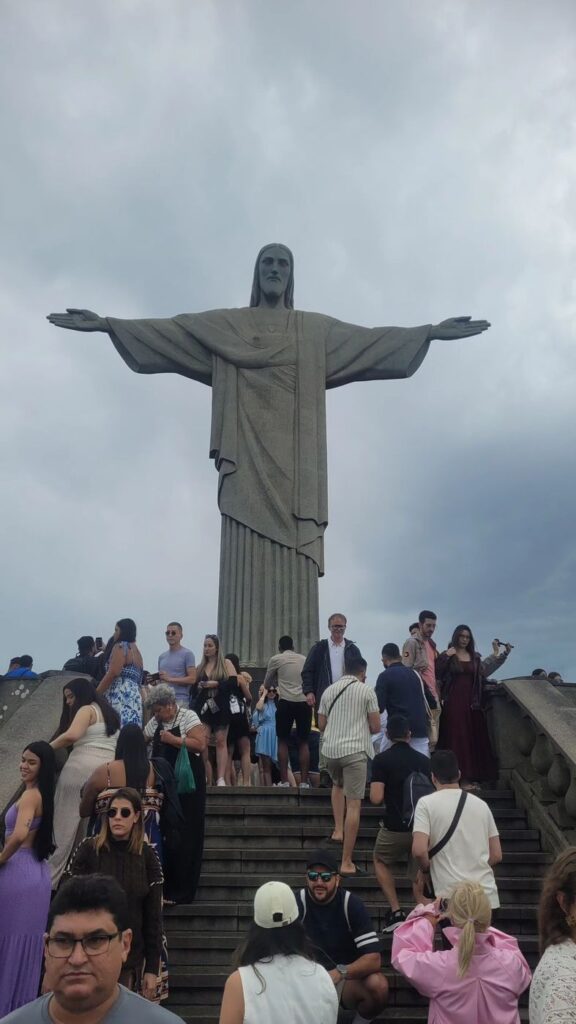
The stairs and escalators up to the platform are being rebuilt through May 2027.
The monument is going through a long renovation. The escalators and the stairways that carry visitors up to the statue’s platform are being rebuilt, and the work is scheduled to continue until May 2027.
While this happens, the site is operating at roughly half its normal visitor capacity.
What this means in practice is simple: fewer tickets exist, and they disappear earlier. In previous years you could sometimes turn up and improvise. Right now, that is a gamble I would not take, especially in high season or on a clear morning after a few days of rain, when every visitor in Rio decides to go up on the same day.
My advice: book your Christ the Redeemer ticket in advance, and treat the time slot as the fixed point your day is built around. Everything else in the neighbourhood can bend to fit it.
Reduced capacity does have one quiet advantage. There are fewer people on the platform at the top, so the space feels less crowded than it did a couple of years ago. If you time it well, you get a calmer visit than most people expect.
The Santa Teresa tram: buy downtown, ride down
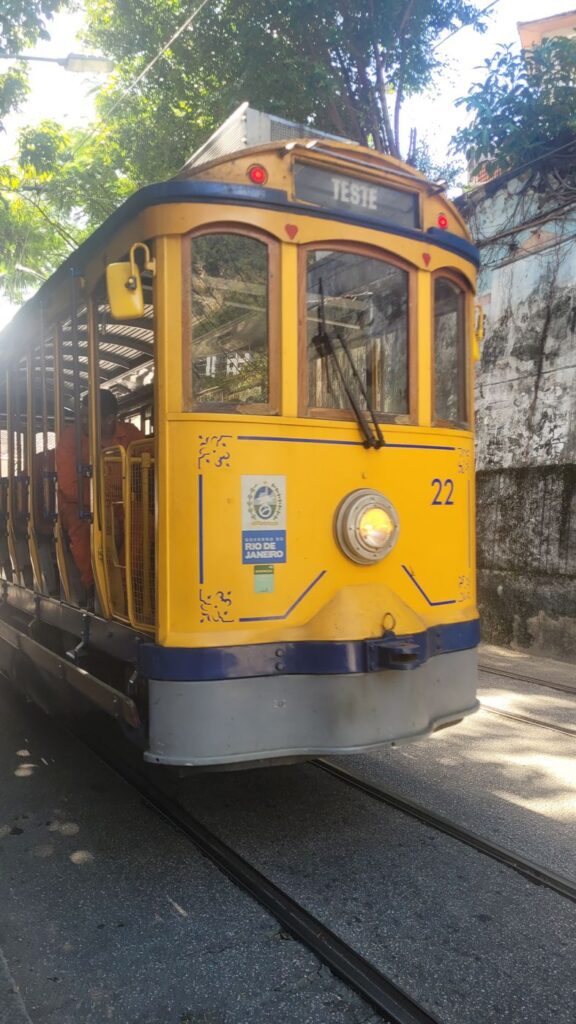
The bondinho climbing through Santa Teresa. Tickets are sold downtown only.
The bondinho of Santa Teresa is one of my favourite things in Rio. It is a small yellow tram, open at the sides, and it crosses the Arcos da Lapa aqueduct before climbing into the hills. It is not transport in any serious sense. It is a ride, and it is wonderful.
There is one rule that catches almost every visitor, and it is worth reading twice.
You can only buy tram tickets at the station downtown, near the Metropolitan Cathedral. There is no ticket sale in Santa Teresa. If you make your way up to the neighbourhood without a ticket in hand and then decide you would like to take the tram back down, you cannot buy one there.
The ticket itself covers both directions, and it is valid for the day you purchase it.
The queue at the downtown station has become very long this year. So here is the approach I now recommend to my guests:
- Buy your ticket at the downtown station near the Cathedral.
- Go up to Santa Teresa by car or taxi.
- Spend your time in the neighborhood.
- Use that same ticket to ride the tram back down.
You lose nothing by skipping the uphill leg. Same ticket, same price, both directions covered. You are simply choosing not to stand in the boarding queue at the bottom, which at busy hours is the longest part of the whole experience.
And honestly, the descent is the better ride. You are facing out over the city as the tram comes down toward the arches, with the downtown towers ahead of you. Going up, you spend most of the ride looking at the hillside.
The Royal Portuguese Reading Room: 30 people at a time
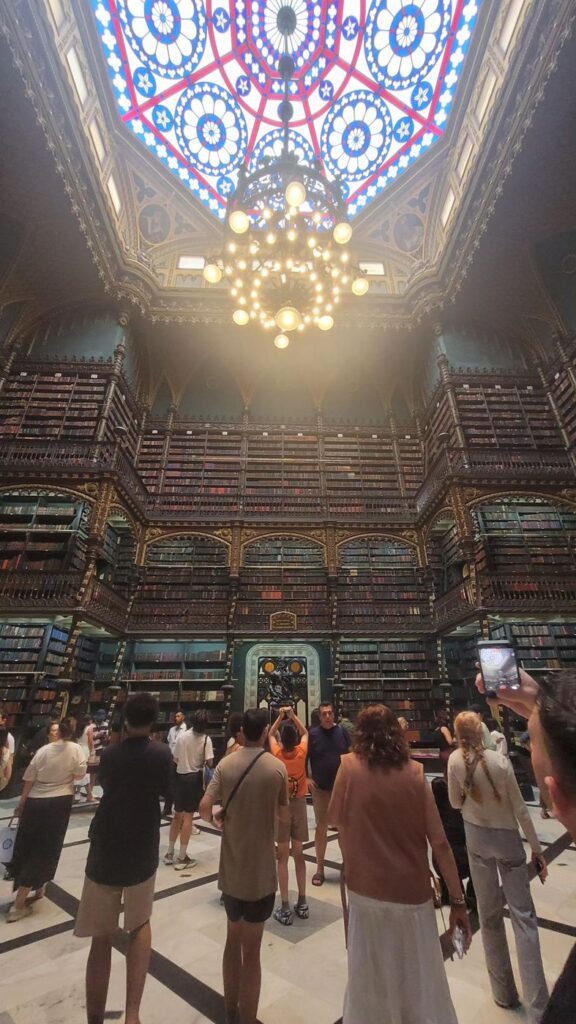
Three storeys of Portuguese volumes under the skylight — now limited to 30 visitors at a time.
The Real Gabinete Português de Leitura is the most beautiful room in Rio, and possibly the most beautiful library I have ever stood in. Neo-Manueline stonework, a vaulted ceiling, and three storeys of dark wood shelves holding hundreds of thousands of Portuguese volumes.
It was, for years, one of Rio’s genuine secrets — a place you could walk into on a weekday morning and have almost to yourself.
That is no longer true. It has become one of the most visited attractions in the city centre, and the library has responded by limiting admission to 30 people at a time. The result is a queue outside that can run to around two hours at peak hours.
I want to set expectations honestly here, because I think two hours in a queue is a real cost in a short trip. The visit itself is not long. You enter, you stand in a magnificent room, you take your photographs, and you leave. It is a few minutes of genuine awe.
Whether that trade is worth it depends entirely on you. Some of my guests would queue all morning for that room and count it as the highlight of their trip. Others would rather spend those two hours walking the old streets of the centre, which are full of things most visitors never see.
If you do want to go, arrive early in the day, before the tour groups reach the centre. And build the queue into your plan rather than hoping it will not be there.
Planning around all three
These three sites sit in different parts of the city and pull in different directions, which is exactly why timing matters more this year than last.
On our Rio private tours, we build the day around whichever of these matters most to you, and we are honest when something is not worth the wait for the kind of traveller you are. That is the advantage of a private guide over a fixed itinerary — the day can be shaped to you, and it can change at ten in the morning if the weather or the queues say it should.
If you are planning a trip to Rio and want to talk through how to fit these in, get in touch. I am happy to give you a straight answer, even when the straight answer is “skip it.”
Conditions in Rio change. This article reflects the situation as of September 2026 and is updated as things shift. The Christ the Redeemer renovation is scheduled to finish in May 2027.

Author Fabio Mendonça
Fábio Mendonça, a native "carioca," has dedicated over 17 years to the tourism and hospitality industry. In 2012, he founded Rio Cultural Secrets, offering personalized private tours that unveil Rio de Janeiro's hidden gems. Fluent in English and Portuguese, Fábio tailors each tour to his clients' interests, ensuring a unique and immersive experience. His expertise and passion have earned him stellar reviews on platforms like TripAdvisor and recommendations from esteemed travel guides such as Fodor's. Beyond guiding, Fábio is also a travel writer, sharing his deep knowledge and love for Rio's culture and history.